

What time is it?
on the doomsday clock, ducklings, and the myth of linear nihilism

I think about the Doomsday Clock a lot, and about the scientists who tend it, scribbling calculations of horror to compute how many seconds humanity has left. Oof, what a job, what a formula. (Number of robots with bombs times number of dry aquifers times number of babies in prison camps times number of hungry people sleeping in tents?)
If you check the Doomsday website, the clock currently sits at 85 seconds to midnight, “the closest its ever been” to complete destruction. Great! I’ll just hide under the covers until further notice.
This threatening ticking does not, unfortunately, fire me up to fight for our future. Instead, it renders me terrified and frozen, frustrated by alarmist projects that disempower real planning and action. But in honesty I must ask: do I not keep my own version of the Doomsday Clock? Do I not spend the day silently etching the list of horrors I encounter onto my heart, only to feel their collective wounding impact while trying to sleep bed at night?
Needless to say, I’m not getting a lot of shut eye. Perhaps it’s that a friend of mine has just been beaten and arrested while peacefully singing at a nonviolent protest; or that a single mom down the block has to leave her children home all summer because there is no safety net and camp is too expensive and she has to work, and they call, afraid a scary man might be at their door. Perhaps it’s reading about the denial of medical care for gravely ill children imprisoned in Dilley or the report that confirms children have been deliberately targeted by military drones in Gaza. Often in my heart, too, it is 85 seconds to midnight, that surely we must be closer than ever, that this is the worst it’s been, because holy shit this is not ok. Tick, tock.
But—is this really how time works? Why are the scientists, (and why is my heart?) so sure we can measure total doom so linearly, mathematically?
The poet Nayyirah Waheed writes:
“I don’t pay attention to the world ending. It has ended for me many times and began again in the morning.”
The more I study history, the more I live through and come out the other side of, changed but nevertheless still here, the more I love this place and my children and this world, I learn that these conditions are not new to those people most affected by systems of oppression. Children and parents have long been separated deliberately: during enslavement in this country, families were intentionally broken apart to keep people in despair and isolation; Native children ripped from homes to be taken to boarding schools, where they often ended up murdered.
adrienne maree brown clarifies:
“Things are not getting worse, they are getting uncovered. We must hold each other tight and continue to pull back the veil.”
I have a hunch that we need to let go of the Doomsday linearity if we are to have a hope at getting out of this mess. Are we closer than we have ever been? Or have worlds been ending and being born always at once? What if we are not in the two dimensional space of linear time plodding towards annihilation, but rather in three dimensional bodies that can to take a step, a breath, a bite towards other possibilities.
What if even now we have all the time we need to seize the potent and ample opportunities to move towards another way?
Jenny Odell, one of these frighteningly brilliant polyglots (artist, naturalist, professor, activist, and mind-expanding writer) articulates in her cheekily named book ‘Saving Time’: “there are two different words for time, chronos and kairos.” (Bear with me.) “Chronos, which appears as part of words like chronology, is the realm of linear time, a steady, plodding march of events into the future. Kairos means something more like crisis, but it is also related to what many of us might think of as opportune timing or ‘seizing the time’. In kairos, all moments are different and ‘the right thing happens at the right point’-- what I find in kairos- time is a lifeline, a sliver of the audacity to imagine something different. Hope and desire, after all, can exist only on the differential between today and an undetermined tomorrow.”
Trying to be a part of shaping an undetermined tomorrow is certainly no small ask. We must ask not just how we can survive in the conditions we live in, but how we can change those conditions themselves. To hold the question: what is the opportunity of the moment of “kairos time” we are in, right now? What possibilities can emerge if we listen deeply enough, and come together to make an answer bigger than any one of us?
Grace Lee Boggs used to ask her students, ‘What time is it on the clock of the world?’ So, it’s 85 seconds to midnight in some systems. But it’s every other time too, all at once. It is only ever now, our overlapping, layered timelines and realities and planes concomitantly true.
Babies are being born, seeds tucked into the ground. My ten year old has been begging us to hatch ducklings for two years. We finally gave in. The ducklings are in our living room— one week old and beyond cute, balls of fluff and chirps and 90% of their bodies are their oversized clown feet and big bills. They are incredibly social and unafraid.
This afternoon I sat in the grass and soaked in the overwhelming sweetness of watching my children cuddle the ducklings, giggling as the golf balls with feathers disappeared under the towering clovers.
They decided to teach the ducklings to follow them, and after learning from the ten year old and then the 8 year old how to belt “One Little Duck” and march around with purpose, even the four year old got them to fall in line and waddle behind her through the yard. All you have to do is march confidently in a new direction while singing, and the ducklings are inspired to follow. Maybe it’s not so complicated for humans either.
It may be 85 seconds to midnight, but it’s also solstice time, when the heat of the sun has so warmed the strawberries that they are ruby, no longer blushing but in their deep red fullness, the smell of ripe fruit so strong you can find them under the leaves with your nose alone.
In New York, it’s a moment of raucousness and jubilation as a politic of care and solidarity wins, pouring a double of joy onto the ripples of the Knicks’ win, forming a cocktail brew that social scientist Dacher Keltner calls “collective effervescence, defined as the joyful feeling of energy and harmony when people are engaged in a shared purpose and might even tap into collective awe.”
My friend Joanna Colwell recently wrote a song that called What time is it? That answers Grace Lee Boggs with three parts.
It’s time to put the chisel in the crack in the wall/ put the chisel in/ we’re gonna make it fall. Don’t be afraid to gather your tools up/ don’t be afraid to pick up the maul/ don’t be afraid to gather your courage/ don’t be afraid/ we will tear down this wall.
You can hear Joanna sing it here:
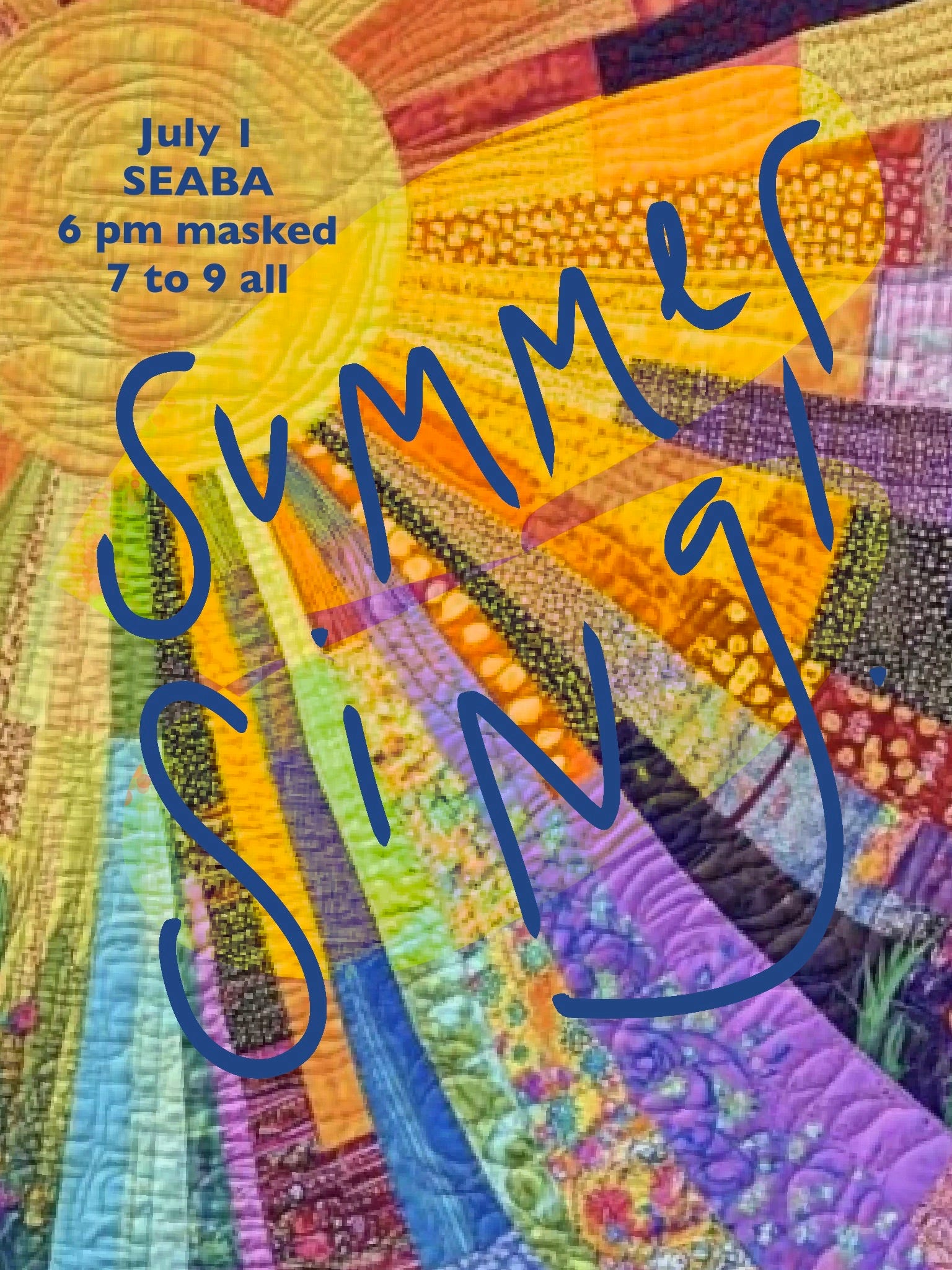
I love Jo’s deep voice backed by her life of activism and courage, and I love even more following her lead and singing it with 250 other people harmonizing and finding their collective power. (If you want to join us, we’ll be back at SEABA on July 1st for community sing, where we’ll surely do this song!)
It may be 85 seconds to midnight, but it’s also about to be Shabbas, an ‘island in time’ during which the hours will stretch and expand as we light candles, pray, feast, stay up too late with ice cream and funny stories or our grief, tending to each others’ wounds, unspooling our tightness from the week through community and ritual. We’re expecting plenty of company; the house is sure to be a clutter of bowls and babies and elders.
Joy Harjo, the Muskogee former-US Poet Laureate, wrote a poem that offers another type of clock. I’ll leave you with it below.
Tonight I am reminding myself this: if the Doomsday Clock clicks forward during Shabbas, even if it strikes full midnight— if the world ends— let us help a new one be safely born by morning. Let us be the kitchen witches feeding each other plates tasting of the new world, let us be the midwives around the birthing table in the dark, here in the only moment we have, now.
Perhaps the World Ends Here
The world begins at a kitchen table. No matter what, we must eat to live.
The gifts of earth are brought and prepared, set on the table. So it has been since creation, and it will go on.
We chase chickens or dogs away from it. Babies teethe at the corners. They scrape their knees under it.
It is here that children are given instructions on what it means to be human. We make men at it, we make women.
At this table we gossip, recall enemies and the ghosts of lovers.
Our dreams drink coffee with us as they put their arms around our children. They laugh with us at our poor falling-down selves and as we put ourselves back together once again at the table.
This table has been a house in the rain, an umbrella in the sun.
Wars have begun and ended at this table. It is a place to hide in the shadow of terror. A place to celebrate the terrible victory.
We have given birth on this table, and have prepared our parents for burial here.
At this table we sing with joy, with sorrow. We pray of suffering and remorse. We give thanks.
Perhaps the world will end at the kitchen table, while we are laughing and crying, eating of the last sweet bite.