

singing our way through
a report out from a song leader convening in Texas + invitations to harmonize for change this week

I’m just back from Texas, where I attended a convening hosted by the Kairos Center. They called in about 170 of us— a mix of song leaders, visual artists, and people of faith from many spaces and fronts of struggle across the country. The organizers presented song as a spiritual, logistical, and political organizing tool. (Amen!)
We gathered under the banner of sharing songs, developing strategy, grounding deeply into our values for the movement of our times and build relationships that will strengthen our movement work across the nation and the globe. Kairos Center has helped tend the fires of change for many years, including the Poor People’s campaign (a moral fusion movement led by the poor), Free Families (to end family deportation), and Songs in the Key of Resistance (organizing songs for social change). They bring together “cultural organizers” to help us get our hearts and minds and songs aligned.
“Kairos is an ancient Greek word, describing a time of great change, when the old ways of the world are dying and new ones are struggling to be born. It is clear we are living through exactly such a time today. This kairos moment is full of both grave danger and rare opportunity, and calls for bold and imaginative action from those who wish to break free from the intolerable conditions of poverty, systemic racism, militarism, ecological devastation, and more. It is in this context that new movements of poor and dispossessed people are emerging across the country and world.”- Kairos Center
“Cultural organizers” are people who use song, visual art, and preaching or narrative to create the culture in which movements can root, thrive, and win. Culture is the water in which we swim. I was humbled to be among many song leaders whose work I admire, too many to name. (But listen to the Peace Poets! Listen to Batya Levine and Aly Halpert and Sarina Partridge and Dr. Charon Hribar and and and!)
Most of the days we spent together were entirely immersed and fully conducted in song. I have never been to a gathering quite like it. We learned new songs, practiced old songs and adapted traditional melodies with new words. We were many kinds of people and from many faith lineages, brought together out of necessity, out of love, out of hope for our shared future, crossing historic lines of division. The songs kept reminding us, like the great gospel power anthem made famous by Hezekiah Walker proclaims: we need each other to survive.
Here was the get- to- know each other part of the gathering, entirely conducted in song:
This song was adapted from a traditional folk song, Bele Mama. Likely of Cameroonian origin, it’s been passed down through oral tradition. Bele Mama translates to “Call Mother” in Oroko, calling in one’s mother to join in to a celebration.
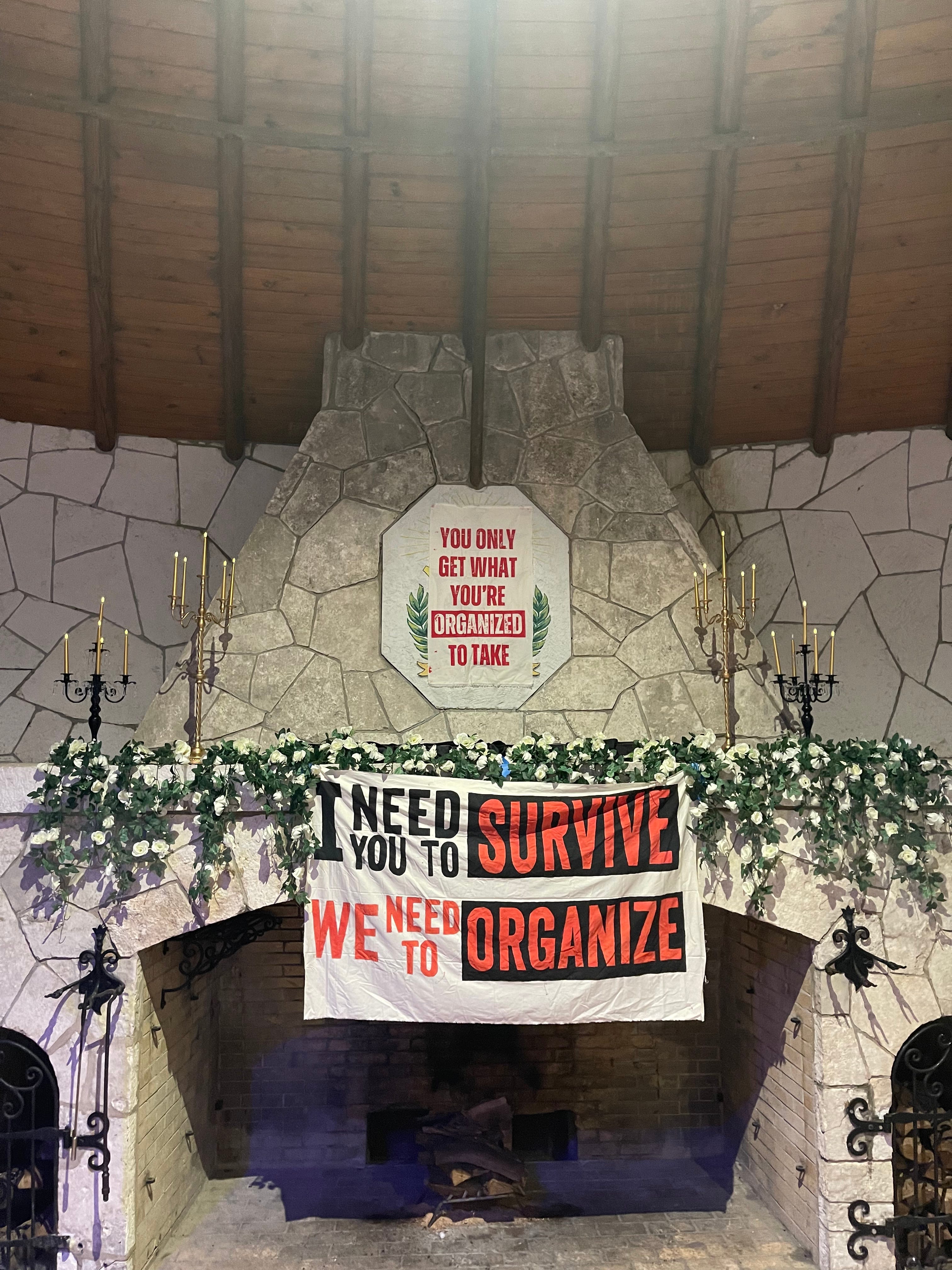
Every piece of the gathering, from children running around (“children aren’t in the way; they are the way”) to bowls of lozenges and tea and covid tests (“we keep each other safe”) to pop up interfaith prayer spaces (“G-d in every moment and person”) helped me feel my way into the world we are building. Because we were already inhabiting it.
And the inhabiting a movement of resistance and possibility felt so FUN. At a late night participant- led sing, we learned versions of ‘Went Down to the Rich Man’s House’ mashed up with Doloy Politzei-- a Yiddish “down with police” song from Jewish bundists who were against the Russian empire that police protected, the songs themselves clarifying the intersections between capitalism and carceral systems.
The more times change…
The songs’ messages, paired with the style of collective leadership helped clarify our movement values, or what comes before strategy. Values matter more than ever as conditions change so rapidly that by the time we develop a plan it is out of date. But grounding in values can support us no matter what comes. (At the organization where I serve as executive director we run all decisions through our six values: trust and integrity and everything we do; care and reciprocity between people in the planet; justice and well-being for all.)
Different leaders seamlessly passed the ball to each other so deftly that songs would almost overlap. Each leader would tell the story of the song: where it came from/ what was the struggle story/ what language is this in/ who adapted the words? The carriers of the songs adding their own story into the songs themselves, each of us shaping and changing the meaning as we carry the tune with us.
Here we are learning “None Of Us Are Free” by Arnaé Batson inspired by the words of Fannie Lou Hamer:
The values that emanated through the whole gathering through were: a sense of the holiness in everyone; robust commitment to peace & the long time horizon that being part of a nonviolent movement requires; beauty as the way; the need to link arms across historic difference; and collective leadership.
The few times organizers did speak to us outside of song was to download some deep political education.
We heard about of moments in historic struggle where it was not clear what strategy made sense, where there was disagreement between allies, where what was going to happen next was not clear. We heard about when John Brown, the abolitionist, and Harriet Tubman discussed his plans to attempt to incite a massive uprising of enslaved people and abolitionists together across the nation. Tubman and Brown were dear friends and allies. They met often to discuss their shared longing for a liberated world. But Tubman was clear that while she admired the strategy Brown was proposing -- it was not her work to do. She needed to continue with going down into the world of enslavement in the south and bringing helping people get to freedom. Brown thought that the time was right and led a rebellion. Brown ended up being killed before he saw the end of enslavement, but Brown and Tubman loved and needed each other, respected each other, and admired each other outside, despite of and outside of and beyond strategic difference.
We also heard about meetings toward what we now know to be the end of Rev. Dr. MLK Jr’s life. He had begun to call meetings together with his closest allies to say: we need to expand our solidarity and our work to organize with all poor people and to oppose the war in Vietnam. He wanted to to oppose militarism and to call for a radical expansion of the justice movement that includes people of color, poor people and people all over the world who are crying out against American military expansionism. Some of his closest people understood where he was going, but many dissented. He was killed 10 months later.
History (especially history told by an oppressive nation up to its own project of nation building) is always political. And the histories that we are given flatten and narrow the experience of what it was to be inside of historical moments of movement.
In Texas, we were being asked to trouble those narratives and hold the complexity of change making. We’re in complex times now, times where we’re not all sure exactly how to get where we are needing to move. We were being reminded that strategic choices in the middle of movement are not simple and have never been simple. We were being pointed back to the fact that we can hold complexity, we can on strategy and still link up arms through our values and our vision. And we must, if we are truly sacred to one another.
Here is My Commitment/ Mi Compromiso written by Oona Valle and Lu Aya of the Peace Poets for the Free Families campaign, adapted and taught by Ciara Taylor:
When things are not clear, when we’re in disagreement, when we’re struggling: a key method for linking arms and remembering we are for each other has always been through song, through art, through making something beautiful together.
Finally, after days of singing together, we took our practice to the street and went to a massive ICE processing facility where people are brought in or come in voluntarily for ice check-in’s. Inside this cement and metal warehouse, people are detained and driven to concentration camps. We watched as whole families with babies and children were taken into the facility and taken out on sprinter vans driving them straight to the concentration camps of Dilley, where we know that children are abused, where children are staging their own uprising and protest. We stood in witness and would not look away.
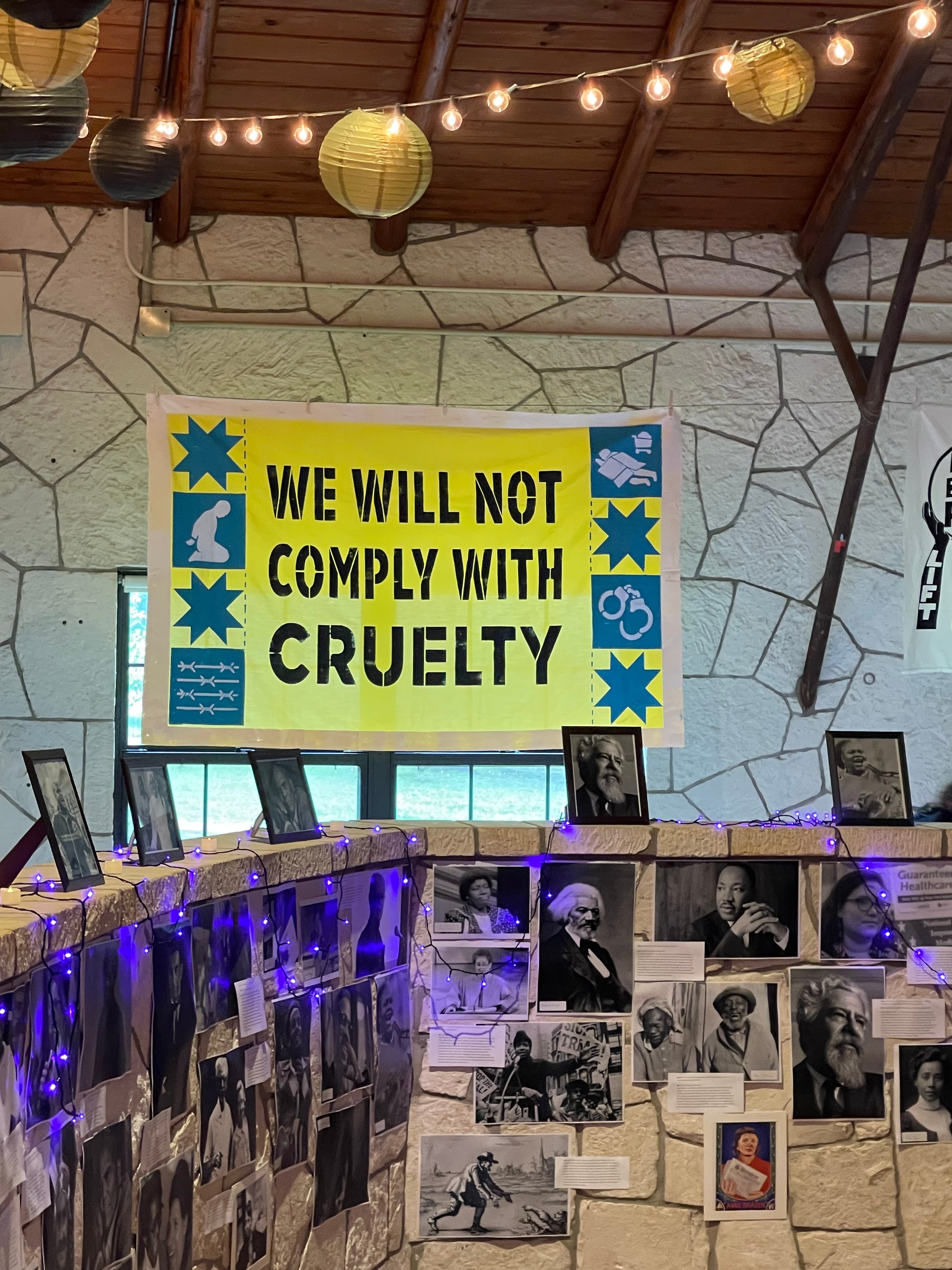
Altars honoring our movement leaders are an important part of creating a shared space, and help contextualize the long lineage of struggle in which we stand.
The experience of watching babies and children shipped out to be taken into camps was heartbreaking in a way that I can’t articulate in words, like staring into the jaws of the machine of fascism, of hatred itself. As a mother, the holy rage that welled up in me has not resolved itself. I bring my rage with me now. I leave it with us all, unresolved, as a call to action, harm we must stop and a wound we must heal.
(A reminder that there are songs for holding rage, too— you can find more in the Songs in the Key of Resistance songbook here.)
In my rage, and in my grief— in my love— I stood with clergy, with elders and youth, with poets and drummers and song leaders and gospel singers. I stood with people whose ancestors kept planting seeds of hope and possibility in the hearts of their children in spite of grave horror. People who held in their bones that another world is possible.
We held up our hands as the buses drove away and we sang our love in the face of hatred. Our hearts broke, but our clarity, our values, and our spirits strengthened. Song can do that, love can do that, solidarity can do that. Ken Saro- Wiwa wrote from the gallows, “Lord take my soul, but the struggle continues.” We will never give up.
It was a joy to carry some of these songs back to Vermont, and I am eager to share them. Yesterday I was able to gather with organizers in the NEK organizing a “Survival Revival” to meet material needs, develop grassroots leadership, take collective action, and share songs in early June. Hit me up if you want to be involved! From there I joined friends on a back porch and learned hospice songs for an elder farmer who is in a passing process as the grackles arrived home on the maple trees. I am so grateful for how no matter the season or the event in our lives, song and community is there.
And THIS WEEK: If you are local and want to learn some of the songs that flowed out of the gathering-- and then take them to the streets: you have good opportunity to do so coming up right up:
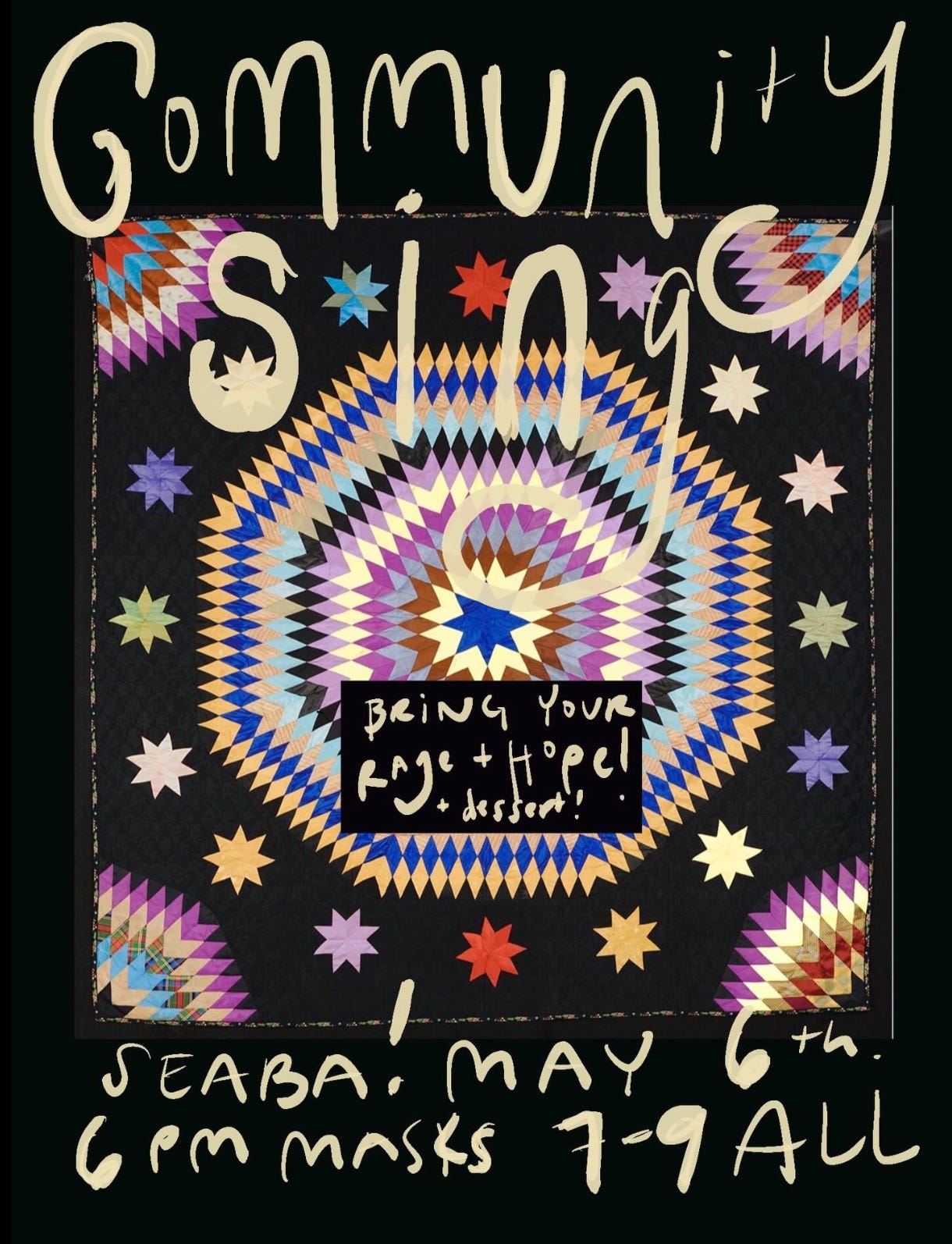
Wednesday May 6th will be singing at SEABA (formerly Arts Riot on Pine St) 6 to 7 is masked only singing and 7 to 9 all are welcome, dessert potluck, and resistance + resilience songs.
Friday May 8th many will be doing an ICE OUT action in Saint Albans at the ICE facility at noon. Don’t miss it!
And— on a final note of song and all it can do for us— I was delighted to be interviewed recently on the Breath of Song podcast with Patricia Norton, and you can listen to the whole episode here! I teach my friend Joanna Colwell’s song called “The Turning” about Joanna Macy’s work of the great turning. Check it out!
And p.s. My friend and comrade Liza Cochran wrote a really beautiful piece, “stay busy with beauty as well as outrage”, and is lifting up our ICE OUT action on May 8th, come out! Anais and Moira and many others will be there and singing out for change. We need you— come add your voice!